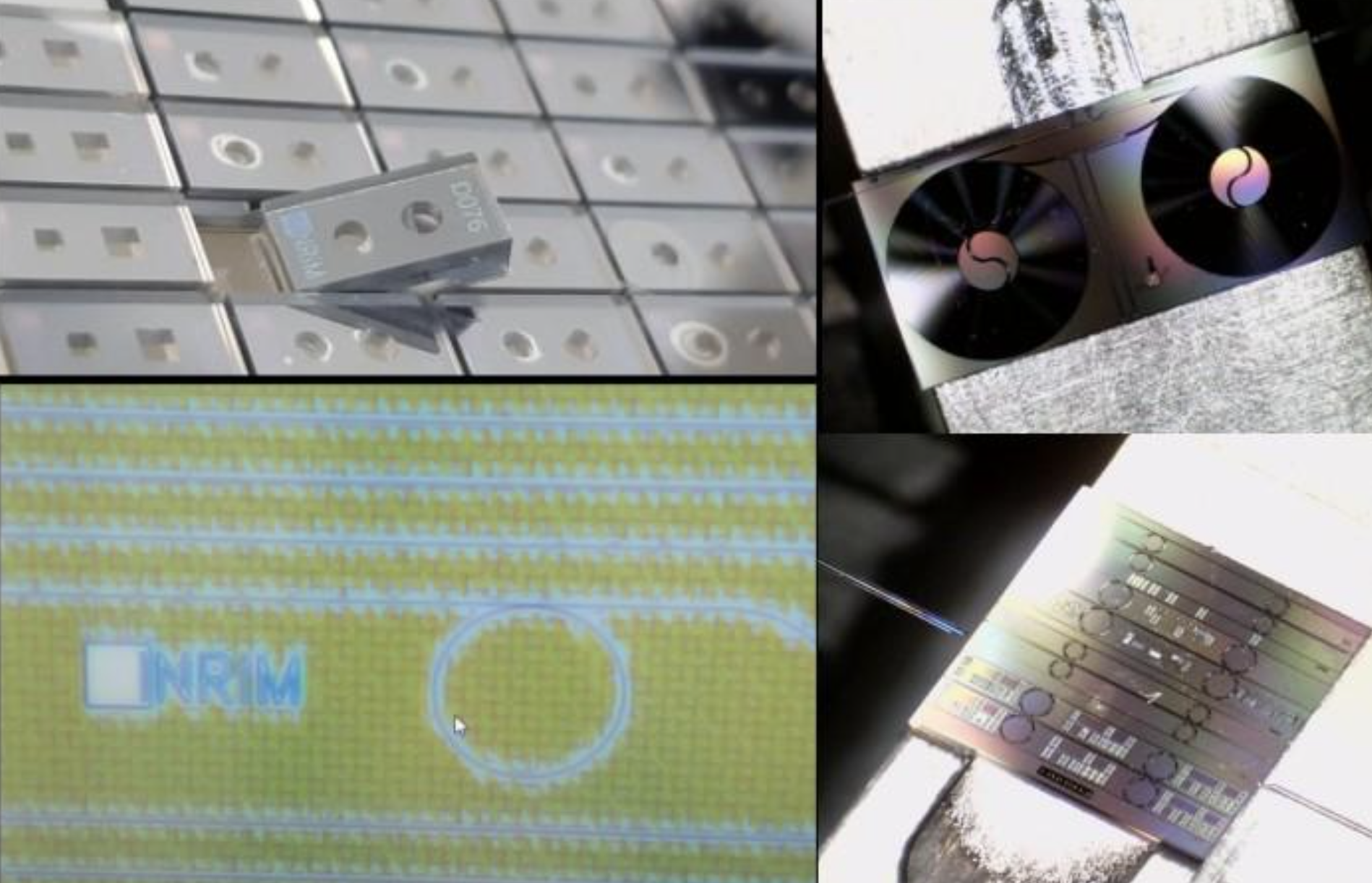
Industrial applications increasingly require accurate time/frequency references under stringent Size-Weight-and-Power (SWaP) constraints. Building on the PiQuET infrastructure, INRiM has launched a new institute-wide research line to develop chip-scale optical clocks, with a target volume of ~200 cm³. Optical transitions are exploited to reach ambitious stability and accuracy, while the key subsystems are integrated on a chip only slightly larger than a 1-cent coin.
The activities develop several tightly connected pipelines:
Hot-vapor microcells (MEMS). Microcells are fabricated using MEMS techniques: cavities etched in a silicon wafer are sealed (“sandwiched”) between two glass wafers and filled with an atomic vapor. The atoms act as an intrinsic frequency reference. Work spans established species (Rb, Cs) and advanced candidates (Yb, Sr, Na, Hg). The microcells are characterized with high-resolution spectroscopy, leveraging INRiM’s experience with cell-based systems.
Cold-atom miniaturization. INRiM develops compact magneto-optical traps that produce ultracold atomic clouds, reducing Doppler and collisional effects and enabling improved clock performance in a compact package.
Optical frequency microcombs. Frequency combs convert an optical reference into a microwave signal usable by electronics. INRiM designs and fabricates silicon-nitride micro-resonators (supported by finite-element modeling); through dispersion engineering and nonlinear dynamics, these microcombs generate evenly spaced optical lines for optical-to-microwave conversion.
- Auxiliary electronics and frequency chains. The project develops the control electronics, synthesis chains and frequency distribution needed to operate the clock, with a roadmap toward progressive integration and miniaturization.