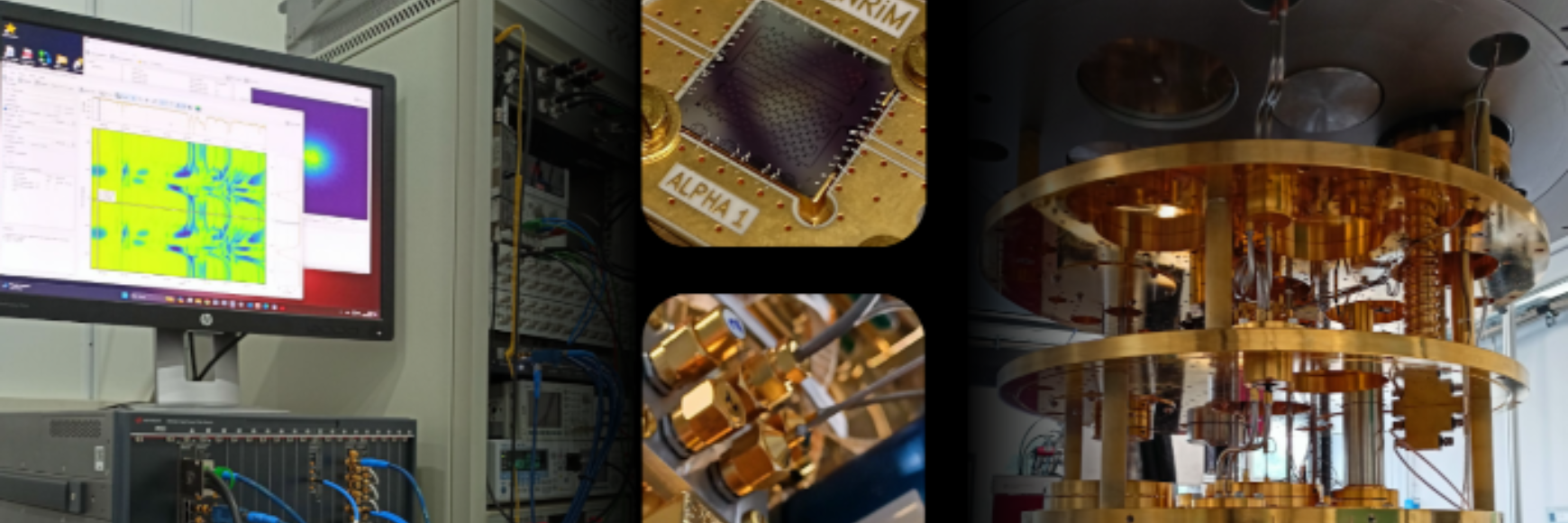
The laboratory hosts a dilution refrigerator operating below 15 mK with magnetic fields up to 9 T and measurement capabilities from DC to 20 GHz. It supports quantum electrical metrology, including single-electron current sources, quantum Hall resistance standards, and superconducting microwave circuits.
The laboratory hosts a cryogen-free dilution refrigerator coupled with a shielded control room, enabling continuous experimental operation without the need for liquid helium refills. The system is based on the dilution of helium-3 in helium-4, a process that allows temperatures below 15 mK to be reached in steady-state conditions.
The experimental platform provides an ultra-low-noise environment characterized by temperatures T < 15 mK, magnetic fields up to B = 9 T, and signal frequencies ranging from DC to 20 GHz. These operating conditions make the laboratory suitable for quantum electrical metrology, mesoscopic physics, and microwave quantum experiments, enabling control of charge, spin, and electromagnetic fields at the single-quantum level.
Two fundamental aspects characterize the facility:
Ultra-low temperatures and high magnetic fields: the dilution refrigeration stage ensures electron temperatures in the millikelvin regime, suppressing thermal fluctuations and enabling the observation of quantum transport phenomena. The superconducting magnet, capable of generating fields up to 9 T, allows the study of quantum Hall devices and other magnetic-field-dependent effects.
Broadband and low-noise measurement infrastructure: the setup integrates filtered DC lines, high-frequency coaxial lines, cryogenic amplifiers, and microwave components optimized for operation from DC to 20 GHz. This architecture enables both precision DC transport measurements and high-frequency quantum manipulation experiments within the same cryogenic environment.
Metrological applications of the laboratory include the development of single-charge quanta transport devices aimed at the realization of the ampere through controlled charge pumping. In these experiments, Cooper-pairs or electrons are transferred one by one at a defined repetition rate, generating a quantized current directly linked to the elementary charge. The platform also supports research on microwave quantum photonics, such as the investigation of superconducting resonators, qubits and hybrid quantum circuits operating in the few-photon regime.
In addition, the facility is used for experiments targeting the realization and dissemination of the unit of electrical impedance through the quantum Hall effect. Pierced by magnetic fields and at cryogenic temperatures, two-dimensional electron systems exhibit quantized Hall resistance values that are directly related to the Planck constant and the elementary charge. The laboratory contributes to the traceability chain of electrical standards within the revised SI framework.