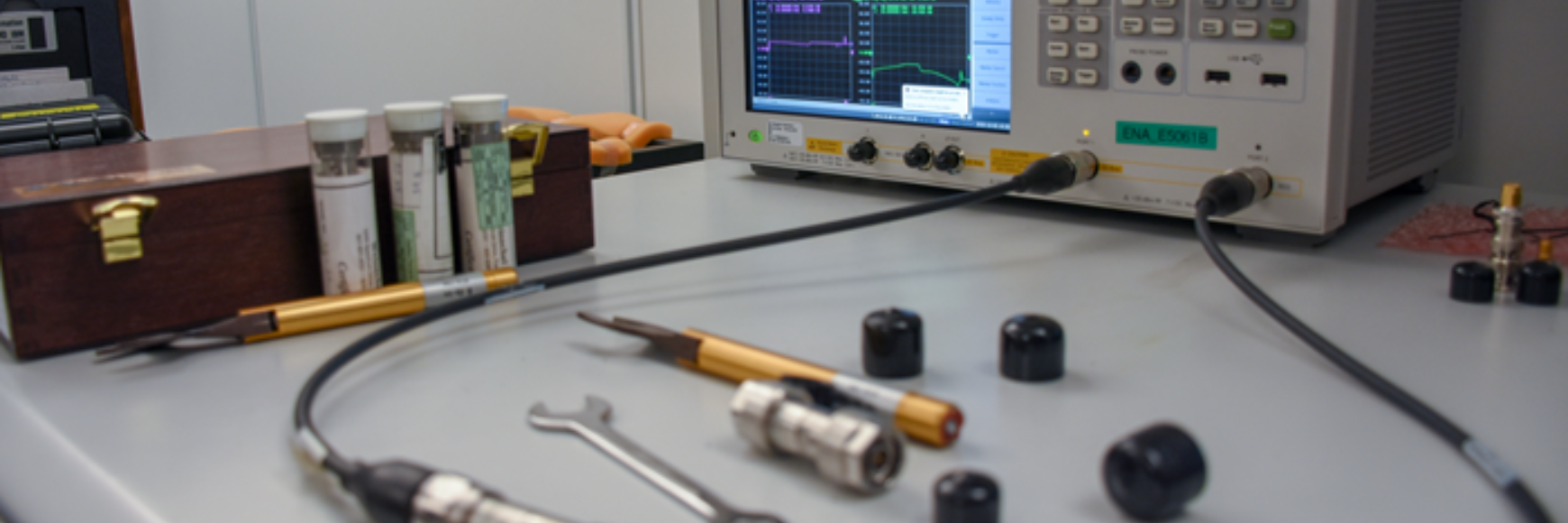
The laboratory, equipped with a temperature and humidity-controlled shielded room, realizes and disseminates the National Standards of power and scattering parameters in the frequency range from 9 kHz to 50 GHz through microcalorimetric systems and vector network analyzers with SI traceability.
Radiofrequency and microwave technologies play a crucial role in modern society, supporting applications ranging from telecommunications and aerospace to industrial manufacturing, healthcare, and scientific research. Ensuring the accuracy and reliability of systems operating at these frequencies requires precise measurement capabilities and rigorous metrological traceability to national and international standards.
The High Frequency Laboratory at Istituto Nazionale di Ricerca Metrologica (INRiM) realizes, maintains, and disseminates the Italian National Standards for high-frequency Power and Scattering Parameters. These standards provide the reference for calibration activities performed for accredited calibration laboratories, industry, and research institutions, ensuring traceability to the International System of Units (SI) and supporting measurement comparability at both national and international levels.
The laboratory operates advanced facilities, including a temperature- and humidity-controlled shielded environment and state-of-the-art instrumentation such as Vector Network Analyzers, Spectrum Analyzers, Signal Generators, and precision Power Meters. National standards for power are realized using microcalorimetric techniques, while scattering parameter standards are maintained using precision vector network analysis systems, covering frequencies from 9 kHz to 50 GHz with full SI traceability.
Calibration services include SI-traceable scattering parameter measurements in coaxial transmission lines with PC-N, 3.5 mm, 2.92 mm, and 2.4 mm connectors across the entire frequency range up to 50 GHz. Waveguide measurements between 50 GHz and 110 GHz are also available using dedicated test port extenders. Power measurements are provided from DC to 40 GHz using calibrated coaxial systems.
In addition to its role in maintaining national standards, the laboratory is actively engaged in research and innovation, particularly in the development and characterization of microwave devices and measurement techniques for emerging applications such as quantum technologies. This includes the establishment of traceable measurement capabilities for high-frequency signals in cryogenic environments, supporting the advancement of quantum sensing, communication, and computing systems.
Through its standards, calibration services, and research activities, the laboratory ensures measurement accuracy, supports technological innovation, and contributes to the reliability and competitiveness of advanced high-frequency technologies.