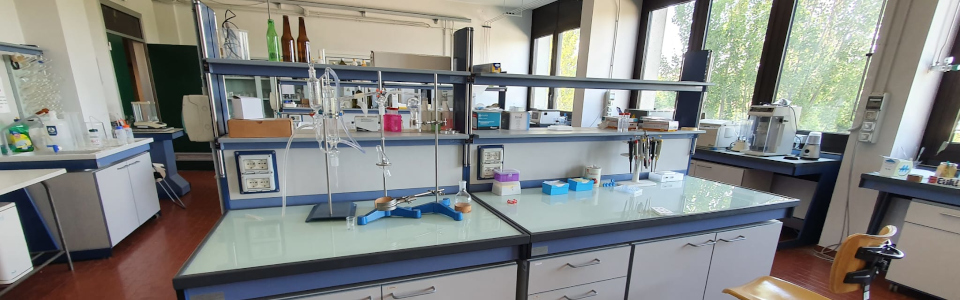
The chemical laboratory serves as the technological core of our research on food matrices and Food Contact Materials (FCM). The facility is equipped with certified workstations, fume hoods, and ventilated cabinets for the safe storage of both liquid and solid solvents and reagents. This setup ensures maximum safety when handling organic solvents, acids, and bases, providing a controlled environment for preparing samples destined for complex chemical and physical analysis.
Since analytical integrity begins with meticulous sample preparation, the laboratory features state-of-the-art equipment dedicated to matrix homogenization and the extraction of analytes of interest (additives, contaminants, and bioactive compounds). Key facilities include:
- Concentration and Extraction Systems: Rotary evaporators and freeze-dryers (lyophilizers) for treating heat-sensitive extracts and preserving matrices.
- Precision Instrumentation: High-resolution analytical balances, including one with a sensitivity of 10^(-7) g, essential for weighing reference standards and nanostructured materials.
- Mechanical and Thermal Processing: High-performance homogenizers, mixers, centrifuges, and presses for preparing model systems and reference materials.
- Ovens, incubators, and ultrasonic baths specifically used for accelerated migration testing and packaging degradation studies.
This infrastructure is vital to supporting our primary research lines. Advanced sample pre-treatment enables the development of multi-class methods for organic and inorganic contaminants, as well as elemental speciation, providing a solid foundation for metabolomics and proteomics studies.
Without precise extraction and purification, it would be impossible to accurately identify compounds or ensure the traceability and authenticity of food and wine matrices. Every instrument is selected to guarantee maximum accuracy in anti-fraud monitoring and the validation of innovative solutions for food safety and sustainability.