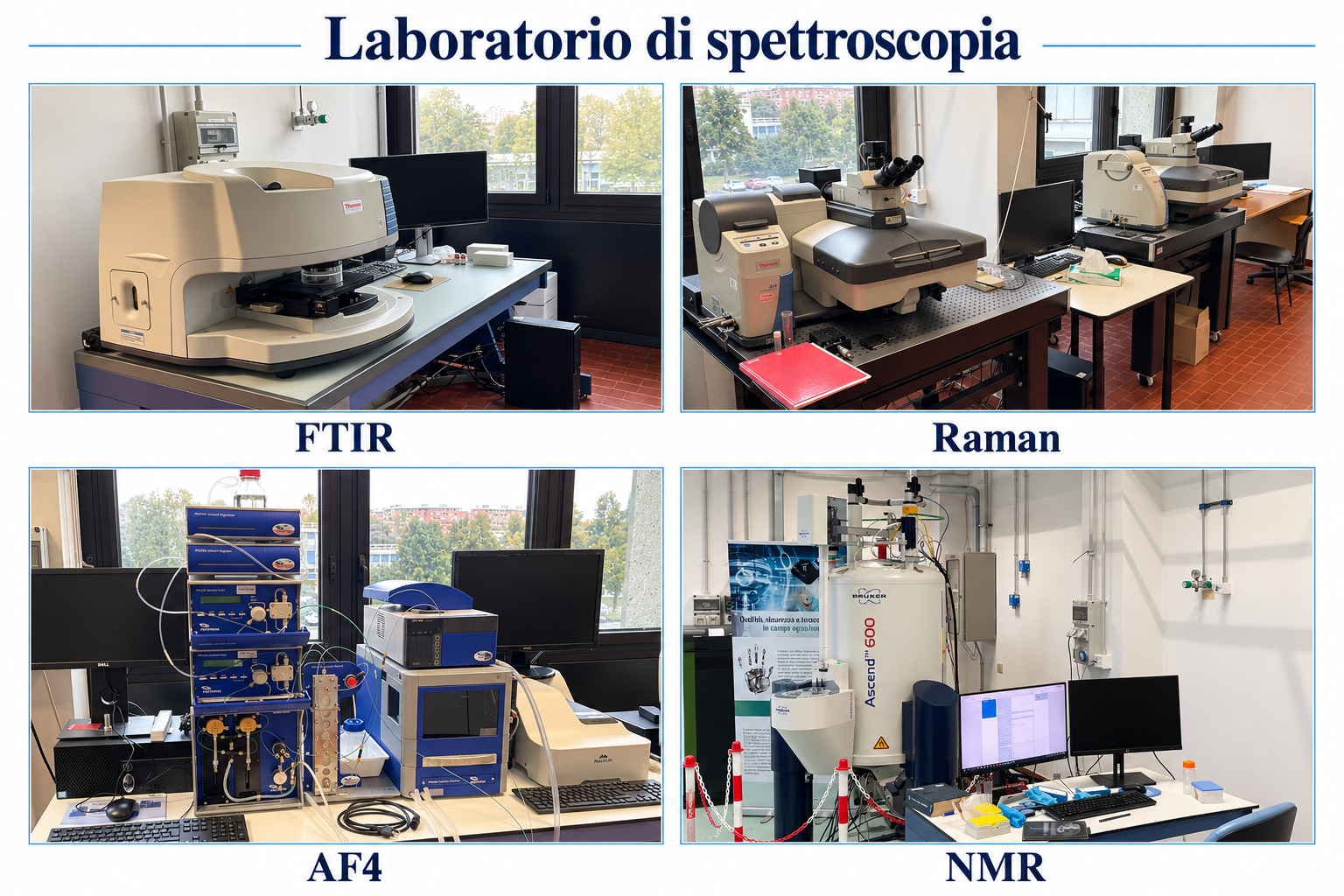
The Vibrational Spectroscopy Laboratory is dedicated to the chemical, physical and dimensional characterisation of materials and particles, including those in complex matrices. It integrates Raman, FTIR and UV-Vis spectroscopy, fluorimetry, AFM and STM microscopy, scattering (MA-DLS), and separation and concentration techniques (AF4, DEP), with correlative and hyphenated systems for micro- and nanoscale analysis.
Optical techniques enable non-destructive analysis of solid, liquid and gaseous matrices, providing specific chemical fingerprints to identify contaminants and species of interest in organic samples, on industrial surfaces and in complex matrices.
The equipment includes two FTIR spectrometers covering the mid- and near-infrared regions, which can be interfaced with microscopes and motorised stages for chemical imaging, and a gas cell with a 6 m optical path length for trace gas analysis. Four micro-Raman spectrometers, with lasers operating at 266, 405, 455, 532, 633 and 780 nm, are equipped with motorised stages and can be coupled to cells for gas-phase analysis. UV-Vis and fluorescence spectrophotometers are available for quantitative analysis.
High-sensitivity Raman techniques include SERS, using nanostructured plasmonic materials for signal enhancement, and TERS. An AFM-Raman system enables correlative chemical and morphological analysis and TERS applications with nanometre resolution. AFM, MA-DLS and AF4 support the dimensional characterisation and separation of micro- and nanoparticles. Dielectrophoretic cells integrated with Raman spectroscopy are also being developed to manipulate and selectively identify particles in suspension. These activities contribute to the development of reliable and sensitive metrological methods for identifying and quantifying micro- and nanomaterials and contaminants.
The laboratory houses a Bruker AVANCE NEO 600 MHz NMR spectrometer with 5 and 10 mm probes, a ²H and ¹⁹F lock system, and an automatic sample changer. The instrument supports the chemical characterisation of food and beverages, metabolomics studies, and quantitative and isotopic analyses. Within the One Health framework, mass spectrometry and nuclear magnetic resonance (NMR) connect the environment, the food supply chain and health. Mass spectrometry identifies and quantifies contaminants, residues and metabolites at low concentrations, while NMR characterises food composition, quality and authenticity, as well as changes associated with production processes and environmental conditions.
Integrated with validated, SI-traceable methods, these techniques provide data to investigate substance transfer along the food supply chain and assess human and animal exposure.