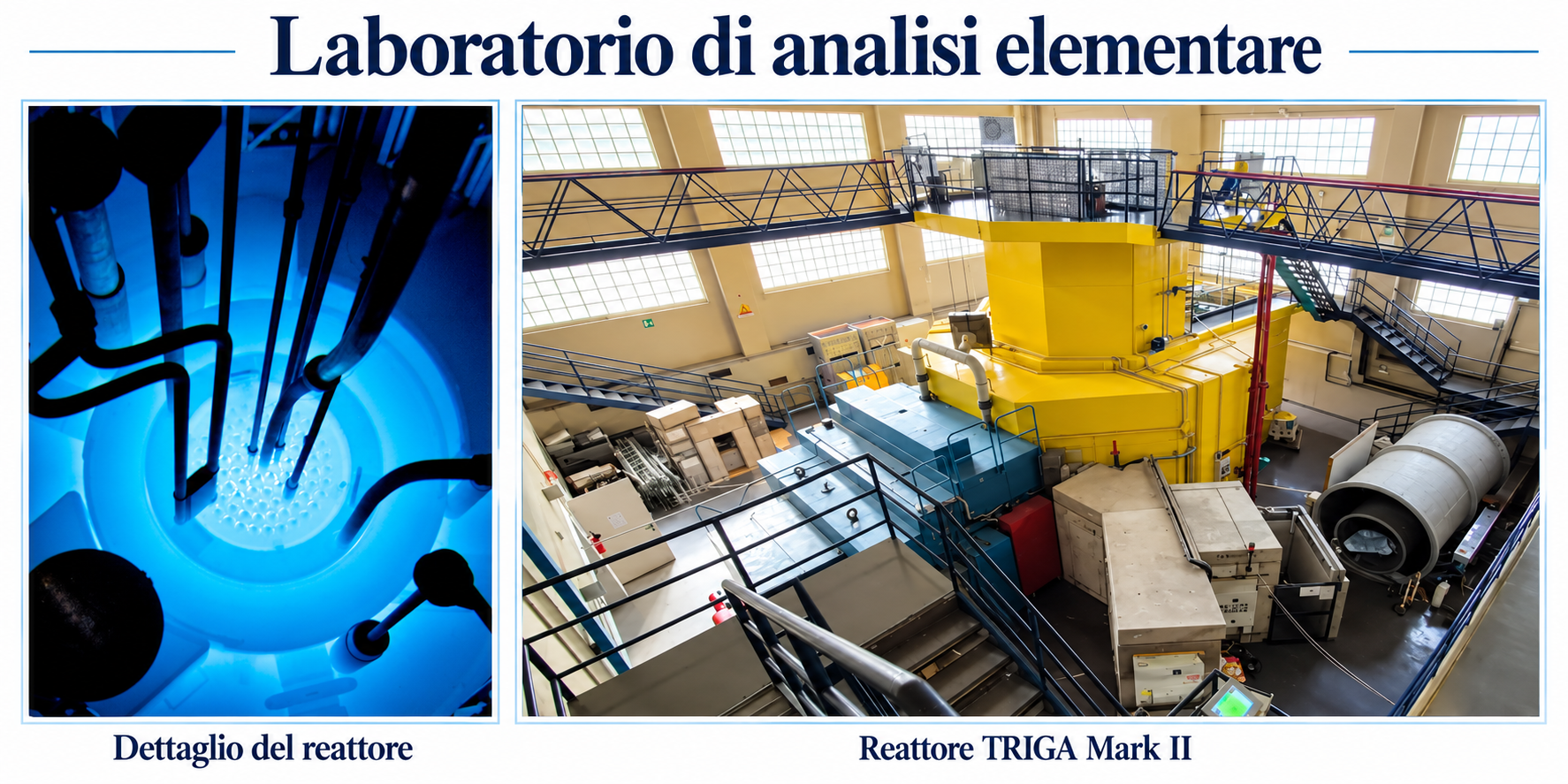
The Elemental Analysis Laboratory is located within the Department of Chemistry at the University of Pavia, near the Laboratory of Applied Nuclear Energy (LENA).
Analytical methods are developed and applied to quantify major, trace and ultra-trace elements in sample matrices. The techniques used are Instrumental Neutron Activation Analysis (INAA), primarily for quantification, and micro-X-ray fluorescence (micro-XRF), which enables both quantitative analysis and surface mapping of elemental distributions.
Neutron irradiation for INAA is performed at the University of Pavia’s TRIGA Mark II nuclear reactor, operated by LENA. Irradiated samples undergo gamma-ray spectrometry using high-purity germanium detectors and multichannel analysers at the INRiM laboratories in Pavia, within the Radiochemistry area. Mass fraction limits of quantification for more than sixty elements of the periodic table range from 10⁻⁹ g/g to 10⁻² g/g, with relative measurement uncertainties as low as 0.2%, depending on the element and matrix.
The available detectors also enable the characterisation and quantification of the activity of gamma-emitting radionuclides in solid and liquid matrices.
Micro-XRF measurements are performed using a Bruker M4 TORNADO spectrometer, with a spatial resolution of 20 µm over surfaces up to 190 mm × 160 mm.
In addition to standard analytical chemistry laboratory equipment, cutting and ball mills are available for grinding sample matrices, along with hydraulic presses for sample preparation.
Metrological traceability to the International System of Units (SI) is established using certified solid and liquid reference materials and certified balances..