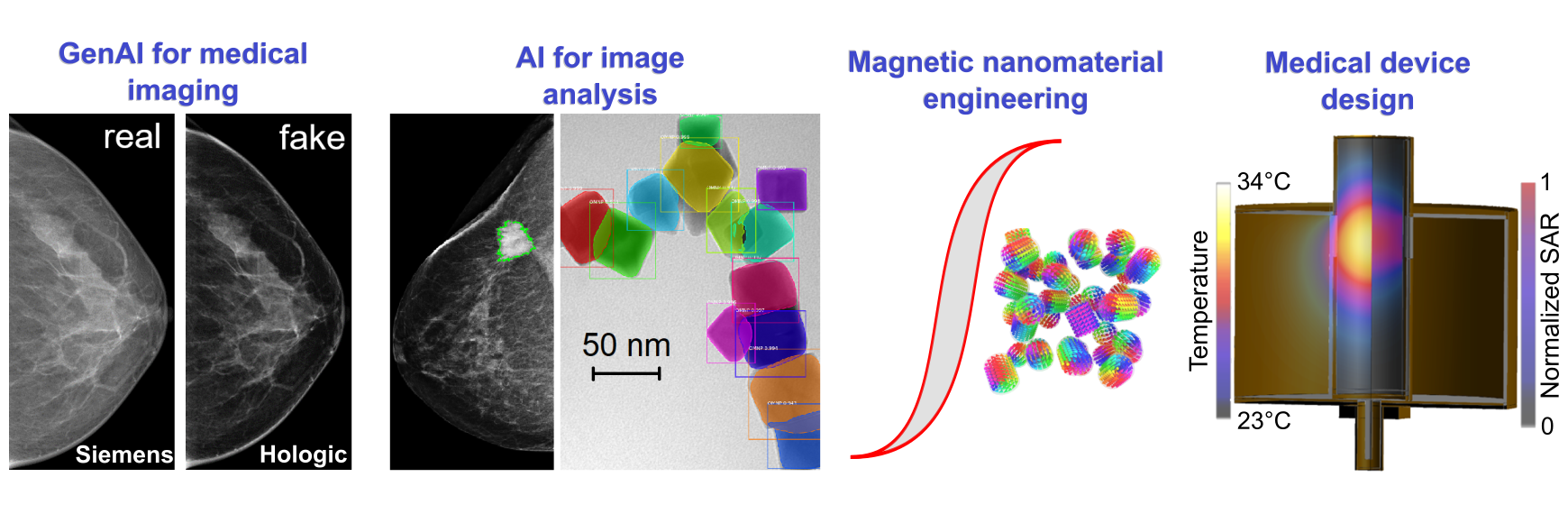
The laboratory develops advanced numerical models, high-performance computing tools and large-scale data-analysis methods, for applications in biomedical engineering, diagnostics imaging, and material science. These goals are achieved integrating efficient numerical methodologies with GPU-based computing, and machine learning algorithms.
Currently, the laboratory is active in three main areas of research.
AI and in silico models for medical imaging
- AI models are designed and validated for automatic detection, classification and segmentation of pathologies in medical images. One application is breast cancer screening via X-ray mammography, where methods for metrological evaluation of accuracy and visual explanation are also investigated.
- In parallel, in silico and generative AI models are synergistically developed for creating datasets of highly realistic synthetic medical images. These are used as digital patients for virtual clinical trials and to supplement clinical image databases, for AI models training and testing. Particularly for X-ray mammography and magnetic resonance imaging, in silico synthesis is performed simulating the entire image acquisition pipeline, starting from anthropomorphic digital phantoms.
Design of nanomaterials and devices for biomedical applications
- A strong focus is placed on magnetic nanoparticles for potential use in therapeutic hyperthermia and diagnostic imaging. Their design is addressed via in-house micromagnetic numerical models, which enables us to optimize shape, size and composition, supporting synthesis and experimental characterization. In silico models are also developed, to simulate the nanoparticle hyperthermia effects in tumour tissues within anthropomorphic and animal digital phantoms.
- Computational design of electromagnetic devices for life sciences and metrology applications is performed, including nano/microsensors for low magnetic signals measurement and in vitro diagnostics (detection of magnetic particles for biomarker screening).
Digital twins and AI for contaminants analysis
- Digital twins are developed to simulate the biophysical interactions between living systems and contaminants (chemical substances, nano/microparticles). One application is the in silico modelling of the placenta intervillous space, for analysing the transfer to the foetus of potentially toxic substances.
Machine learning models are designed to quantify contaminants (e.g. microplastics) in food, environmental and biological samples, providing a reliable dimensional characterization for toxicological risk assessment.