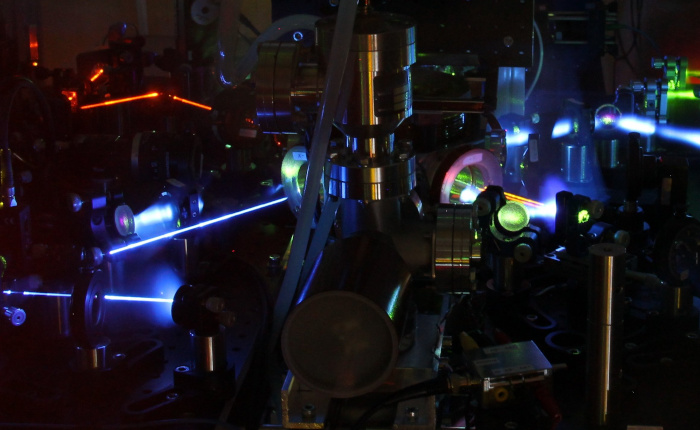
INRiM developed an optical lattice clock based on neutral ytterbium (Yb) atoms trapped in an optical lattice. In an optical lattice clock, thousands of atoms are confined in the standing wave of a laser so that their motion is strongly reduced, allowing long interrogation times and high signal-to-noise ratio. The Yb clock transition lies in the optical domain at 578 nm, enabling much lower uncertainties than primary microwave clocks and making Yb clocks strong candidates for a future redefinition of the SI second.
The current plan includes the development of a new stationary Yb optical clock and of a portable optical clock, alongside new international comparisons and further contributions to TAI using the currently operating system. Technical work continues on systematic-shift control (including blackbody-related effects), robustness and operational reliability.
Optical clocks are also powerful sensors. In 2016, the INRiM Yb clock participated in a proof-of-principle relativistic geodesy experiment together with a transportable optical clock developed at PTB, using clock frequency comparisons to probe differences in gravitational potential.
Within the Sector, the Yb clock provides high-accuracy data to support UTC(IT) and to validate the frequency of local oscillators. It also underpins optical-clock comparisons over fiber links, including those enabled by the Italian Quantum Backbone, and contributes to international campaigns aimed at assessing reproducibility and consistency among optical standards.
The laboratory integrates atomic physics, ultra-stable laser systems and precision measurement methods. Traceability is ensured through documented uncertainty budgets and by linking measurements to recognized standards, enabling both scientific use and metrological reporting.