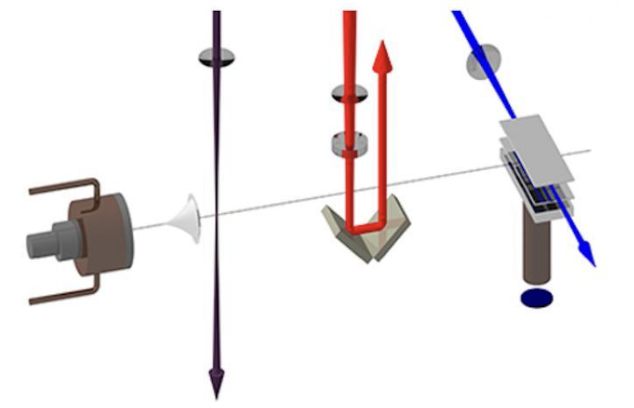
High-resolution molecular spectroscopy is a powerful tool for addressing fundamental questions in physics and for developing new frequency references. This activity is based in the INRiM laboratories of Sesto Fiorentino (Florence area).
The laboratory develops new methods to cool and control neutral molecules and applies them to improve spectroscopic resolution. A current line of work is a buffer-gas source to prepare an effusive beam of cold molecules, with the prospect of implementing laser cooling. In parallel, INRiM collaborates with colleagues at INO-CNR, who associate ultracold atoms to produce dense ensembles of ultracold molecules. The current plan includes trapping ultracold CaF molecules and the development of an ultracold molecular platform including Yb-Cr atomic mixtures, molecular association and laser-spectroscopy studies, expanding the range of systems accessible to traceable high-resolution spectroscopy.
A key enabling element is the connection to the Torino frequency standards. The laboratory’s laser systems are locked to the reference frequency in Torino via an optical fiber link, providing traceability and stability for spectroscopy from the UV to the mid-IR.
These capabilities support precision measurements, searches for small effects beyond standard models, and the development of molecular systems relevant to quantum technologies. By combining cold-molecule sources, advanced laser systems and fiber-linked references, the laboratory delivers a platform for spectroscopy at unprecedented resolution with direct traceability to national standards.
Molecular systems offer rich internal structure that can be exploited for tests of fundamental physics, improved molecular constants and the exploration of symmetry-violating effects. They also provide routes to new frequency references and to quantum control schemes complementary to atomic platforms. The laboratory therefore integrates metrological aspects, traceability, line-shape modeling and uncertainty evaluation, with experimental developments in molecule production, cooling and detection.
By operating in close connection with the Time and Frequency Sector in Torino, the activity ensures that spectroscopic results can be referenced to primary and optical standards and compared to measurements in other laboratories. This combination of local experimental capability and remote traceable references is a core asset for precision spectroscopy in Italy.