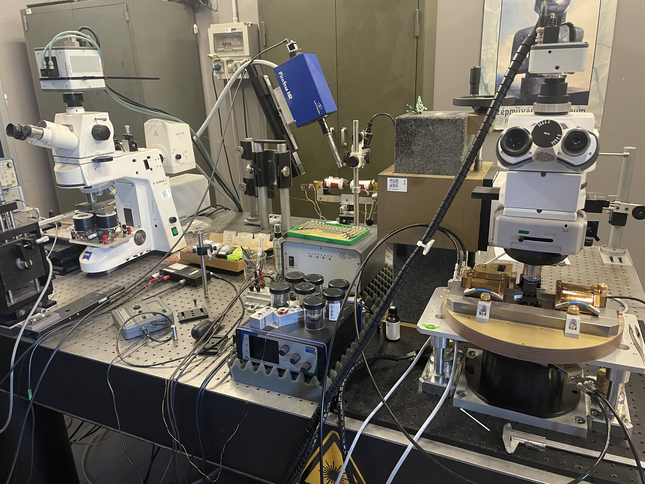
The primary physical effect used in many of the laboratory's instruments is the magnetooptical Kerr effect, used to visualize the domain structure of magnetic materials. Due to the Kerr effect, the polarization plane of the incident light is rotated after reflection from a magnetized medium.
Two high-resolution microscopes (a modified Zeiss AxioScop 2 Plus and an Evico Magnetics microscope) allow the visualization of magnetic structures at the submillimeter scale down to a minimum resolution of approximately 300 nm in magnetic thin films, materials of significant technological interest. The time resolution is of the order of ~ 30 ms.
These microscopes can operate either via the polar Kerr effect, to visualize magnetized structures perpendicular to the film plane, or via the longitudinal/transverse Kerr effects, suitable for magnetized structures in the film plane.
Control of the applied magnetic field allows the application of arbitrary magnetic fields in the field and out of the field plane. Single image acquisition, video sequences, and parallel acquisition of the magneto-optical hysteresis loop are possible.
A low resolution setup is available to investigate large magnetic structures (millimeter scale) in bulk materials (e.g. sheets or ribbons).
The magneto-optical setup makes use of a X-Cite series 120 lamp whose light is filtered, polarized and detected by a low-resolution microscope and acquired by a gated intensified charge-coupled device (CCD) camera (Picostar LaVision).
This permits one to acquire equally time-spaced images at given frequency along the magnetization loop. The stroboscopic observation allows the study of the magnetization process in the presence of fast dynamics, allowing the observation of the motion of domain walls at high frequency. Using a fast LeCroy 816Zi oscilloscope it is possible to control the camera gating during the process.