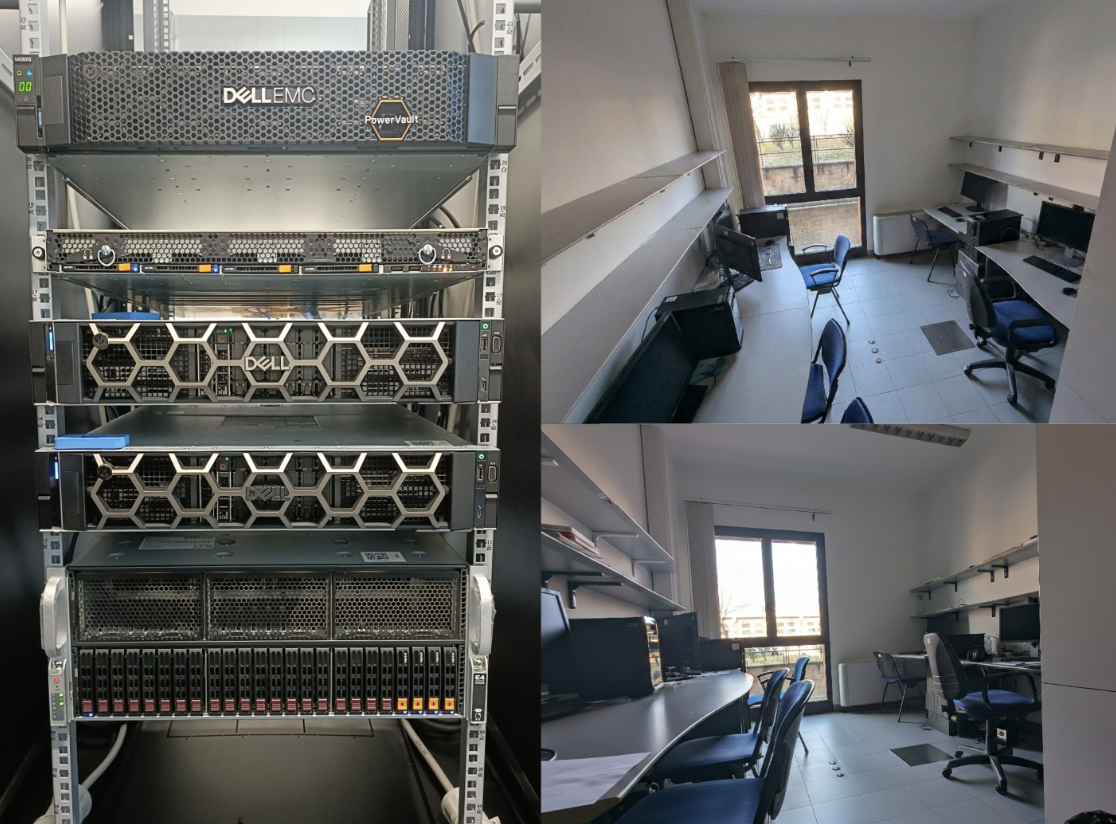
To support our research, the lab features high-performance servers: dual Intel Xeon Gold 6330 processors (112 threads, 512 GB RAM) and SAS SSD storage. Acceleration is provided by two 48 GB NVIDIA L40S GPUs, optimized for intensive micromagnetic simulations and machine learning workloads.
The lab's research is dedicated to the theoretical study and advanced modeling of complex magnetic materials using a multiscale approach. The scientific goal is to predict and interpret the behavior of magnetic and spintronic systems of both fundamental and applied interest, combining fundamental physics models with cutting-edge computational techniques.
Our research activities are organized into four main pillars:
Electronic and Spintronic Properties: Development of predictive computational models based on band structure to calculate and interpret fundamental properties and spintronic transport phenomena in materials;
Atomistic Modeling: Investigation of magnetic properties at the fundamental scale through atomistic simulations, focusing on the unique physico-chemical properties of ultra-thin magnetic materials;
Micromagnetic Simulations: Study of magnetization dynamics at the nano-to-micrometer scale in advanced materials, with a specific focus on systems governed by chiral interactions (such as the Dzyaloshinskii-Moriya interaction) and 3D systems like magnetic nanopillars and nanowires;
- Experimental Integration via Machine Learning: Implementation of Machine Learning algorithms acting as a synergistic interface between theoretical simulations and experimental setups, optimizing data interpretation and guiding the design of new experiments.