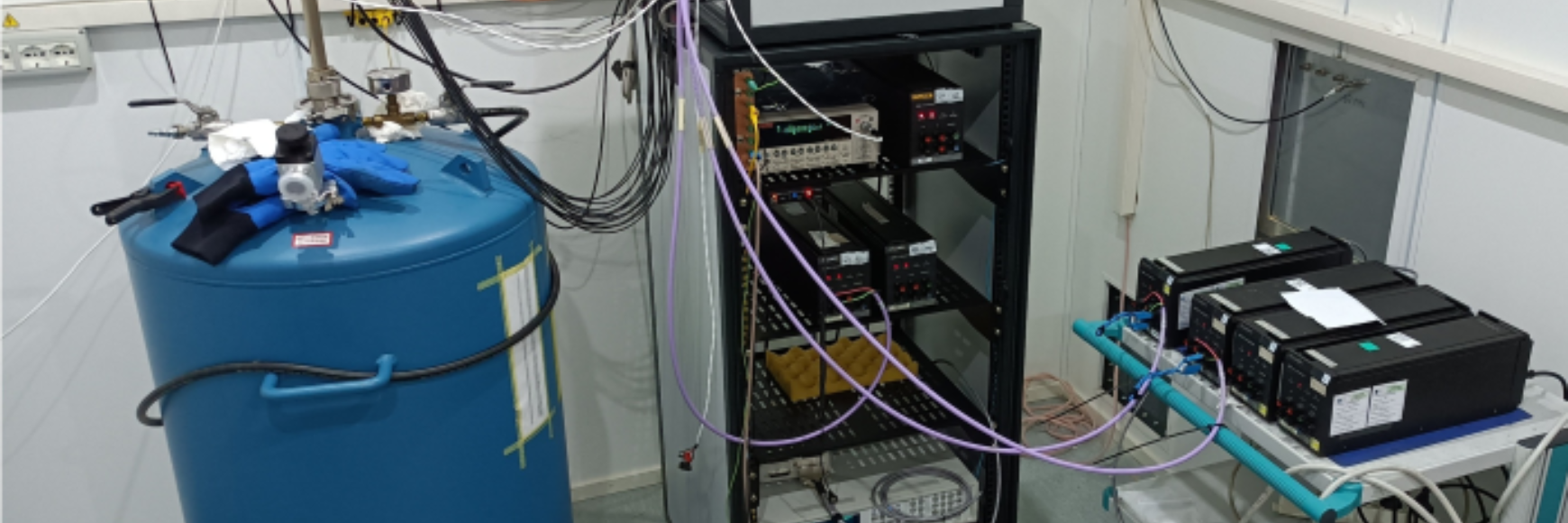
The laboratory realizes the volt unit through the Josephson effect. The primary voltage standard, cooled at 4.2 K in liquid helium, generates up to 10 V DC with accuracy <1 ppb. A closed-loop cryorefrigerator supports research to simplify the cooling of Josephson devices and extend their use to the AC regime.
The laboratory realizes the volt (V), the SI unit of electric potential, by means of the Josephson effect, a macroscopic quantum phenomenon that enables the generation of perfectly quantized voltages directly traceable to the fundamental constants of the SI: the Planck constant, the elementary charge, and the hyperfine transition frequency of the cesium-133 atom. When a Josephson junction is irradiated with an alternating (AC) signal, typically in the microwave regime, it produces quantized voltage levels that are linked with extremely high accuracy to the applied microwave frequency. This principle makes it possible to realize primary voltage standards with stability and accuracy at the highest metrological level (better than 1 part per billion).
Two fundamental aspects characterize these systems:
a) Cryogenics: to achieve the superconducting state, Josephson junctions must be cooled to temperatures close to absolute zero.
b) Scalability: a single junction irradiated at 70 GHz develops a quantized voltage of approximately 150 µV; to obtain practically useful voltage levels (>1 V), thousands of junctions are connected in series.
The primary DC voltage standard consists of a Programmable Josephson Voltage Standard (PJVS) including approximately 70,000 junctions connected in series and cooled to 4.2 K in a liquid-helium cryostat. The system is capable of generating quantized voltages up to 10 V with extremely high accuracy and represents the national primary reference for the calibration of high-end electronic instrumentation, such as solid-state voltage references (e.g., Fluke 732) and ultra-high-precision digital voltmeters such as the Keysight 3458 and the Fluke 8588.
The laboratory also operates a closed-cycle pulse-tube cryocooler capable of reaching temperatures below 4 K without the use of cryogenic liquids. This system is employed for research activities aimed both at extending the use of Josephson devices to the AC voltage regime, for frequencies up to 1 MHz, and at simplifying operation through the progressive replacement of liquid-helium-based systems. In addition to PJVS arrays, this platform is used with pulse-driven Josephson devices, also known as Josephson Arbitrary Waveform Synthesizers (JAWS), in which the conventional sinusoidal radio-frequency signal is replaced by trains of extremely short pulses (<1 ns) repeated at rates up to 15 GHz, enabling the synthesis of arbitrary quantized and calculable waveforms directly traceable to the SI.