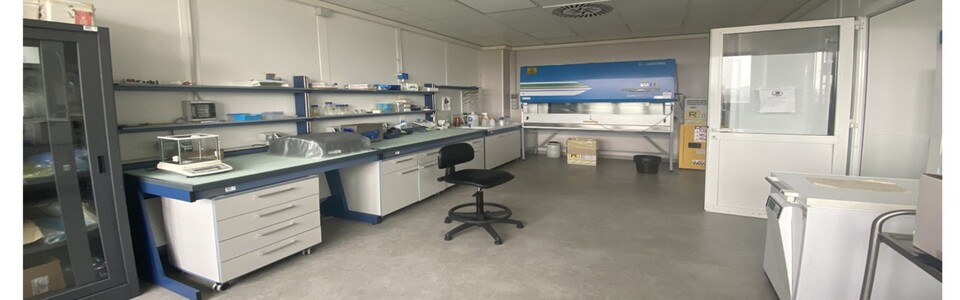
The Class II Biosafety Laboratory enables the cultivation, handling and analysis of microorganisms of diagnostic and food relevance, including bacterial strains such as Escherichia coli, Staphylococcus aureus, Pseudomonas aeruginosa and Listeria monocytogenes, through standard microbiological methodologies and innovative approaches integrated with advanced analytical techniques.
The laboratory is equipped with a Class II laminar flow biological safety cabinet, autoclave for sterilization, temperature-controlled incubators, refrigerators and a –80 °C freezer for strain and sample storage, bench centrifuges, a UV-Vis spectrophotometer and a UV-Vis/fluorescence microplate reader for quantitative growth assays, cell viability evaluation and inhibition curve determination.
Activities include bacterial susceptibility testing to antibiotics and biocides, evaluation of antibacterial properties of materials, surfaces, nanoparticles and nanosystems through standard microbiological tests, as well as sterility assessment of nanomaterials. Quantitative analysis of antimicrobial properties of non-porous and plastic surfaces is also performed according to ISO 22196:2011.
The laboratory supports research on micro- and nanomaterials, with particular focus on interactions between micro/nanomaterials and biological systems (cells and bacteria), including internalization processes, biocidal activity, protein corona formation and effects on microbial growth. Analyses of micro- and nanoplastics in complex matrices under sterile conditions are also carried out, supporting contamination studies, food safety assessment and risk evaluation.
The integration of microbiological expertise with metrology applied to micro/nanomaterials enables the development and validation of reliable and reproducible protocols for the characterization of innovative materials, functionalized surfaces and devices with antimicrobial properties in environmental, food and industrial contexts.