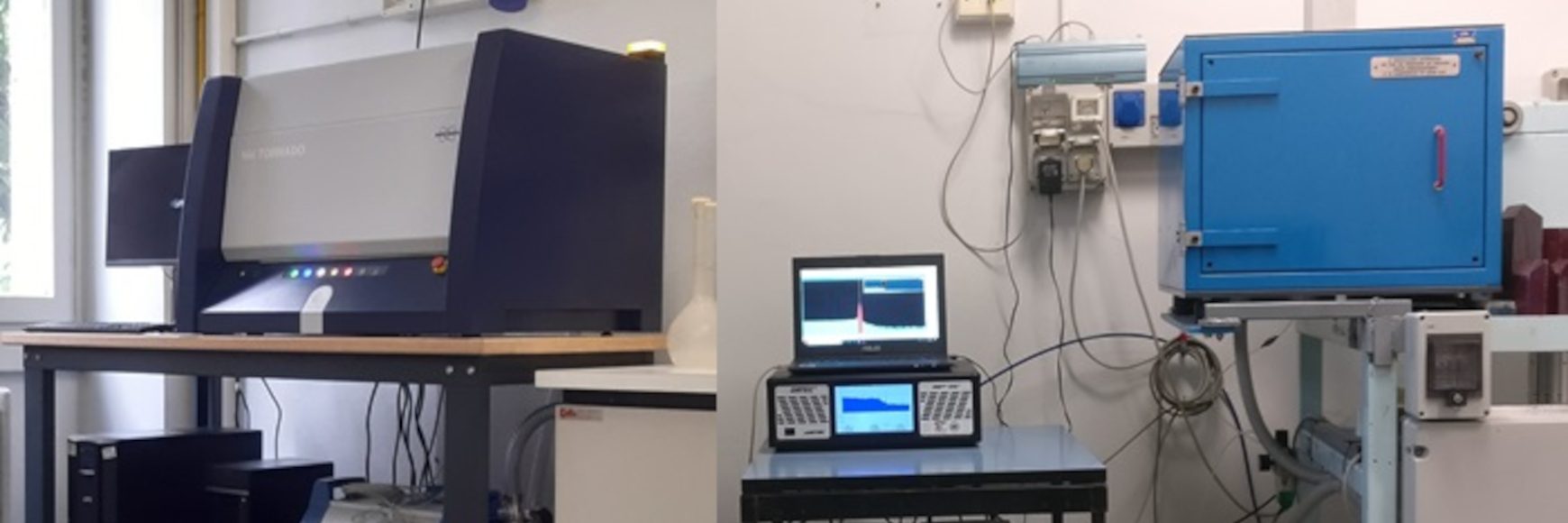
The laboratory is located within the Department of Chemistry at the University of Pavia, close to the Applied Nuclear Energy Laboratory (LENA).
The infrastructure, health surveillance services, and installed instrumentation allow the development and application of analytical methods for (i) the quantification of major, trace, and ultra-trace elements in solid and liquid matrices, (ii) the mapping of elements on solid surfaces, and (iii) the characterization and quantification of the activity of gamma-emitting radionuclides in solid and liquid matrices.
The techniques used are Instrumental Neutron Activation Analysis (INAA), X-ray fluorescence microscopy (micro-XRF), and gamma-ray spectrometry (HPGe).
In addition to the equipment commonly found in an analytical chemistry laboratory, cutting and planetary mills are available for grinding the matrices to be analyzed, as well as hydraulic presses for sample preparation.
Metrological traceability to the International System of Units (SI) is established using solid and liquid certified reference materials.
Neutron irradiations for INAA are performed in the channels of the Triga Mark II nuclear research reactor operating at LENA, while irradiated samples are measured in the laboratory using three ORTEC/AMETEK HPGe chains. Quantification limits for the mass fraction of more than sixty elements of the periodic table are achieved between 10-9 gg-1 and 10-2 gg-1, with relative measurement uncertainties up to 0.2%, depending on the element and matrix.
Micro-XRF measurements are performed with a Bruker M4 Tornado spectrometer with a spatial resolution of 20 μm on surfaces up to 190 mm × 160 mm. Mass fraction determination limits for more than eighty elements of the periodic table (from sodium to uranium) are achieved between 10-4 gg-1 and 1 g-1, depending on the element and matrix.
The quantification and characterization of gamma-emitting radionuclides is performed using the three HPGe chains calibrated for counting efficiency by certified gamma sources. Activity measurement uncertainties up to 2% are achieved, depending on the radionuclide and matrix.